
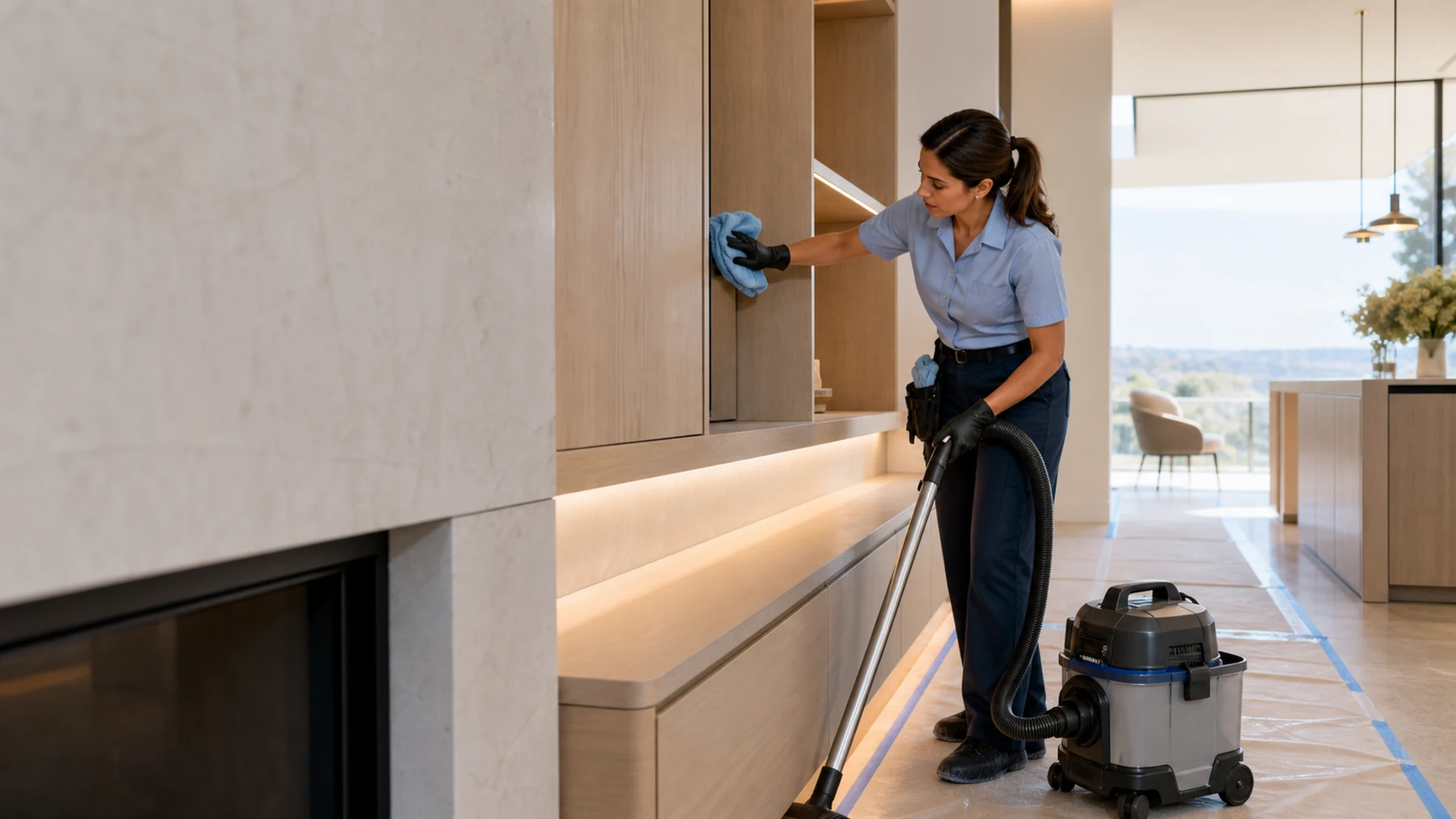
Understand what routine cleaning can address, when to pause, and when fire-restoration, HVAC, or construction specialists should take over.
First determine whether the property has been released for normal occupancy and cleaning. Active fire conditions, visible soot, fire-extinguisher residue, water damage, strong persistent smoke, or dust from potentially hazardous building materials are outside routine housekeeping. Follow local authority guidance and contact a qualified fire-restoration, environmental, or construction professional as appropriate.
Ventilation is not automatically the first step. During a wildfire smoke event, outdoor conditions may be worse than indoors, while construction areas may need containment to keep dust from traveling. Use current local guidance and the building's HVAC instructions; filter selection, duct inspection, and system changes belong with a qualified HVAC professional.

Once the area is cleared for ordinary cleaning, begin with settled loose dust using equipment and attachments approved for the surface. Avoid dry sweeping, which can redistribute fine material, and do not use a household vacuum on widespread soot or unknown construction debris. Large or recurring deposits warrant professional containment and extraction.
Clean hard surfaces in small sections with a compatible product, then inspect the cloth and finish before continuing. Painted walls, natural stone, unfinished wood, electronics, and specialty coatings may need different methods. Never mix products or increase concentration in an attempt to remove smoke odor.
Wash removable textiles only when their care labels allow it. Drapery, rugs, upholstered furniture, and garments with persistent odor or visible residue should be evaluated by an appropriate textile or restoration specialist. Steaming alone should not be treated as smoke remediation.
Post-Construction Cleaning can address ordinary settled dust after trades have finished and the site has been declared ready for cleaning; it is not fire, mold, asbestos, lead, or hazardous-material remediation. Recurring Cleaning may help maintain the home after specialist work is complete, but continuing odor or residue should be referred back to the restoration or HVAC team.
Classify the event before anyone begins ordinary cleaning
Smoke, soot, ash, and construction dust describe different conditions that cannot share one universal reset. Begin by identifying the event, affected materials, duration, visible residue, building status, and any direction from fire officials, environmental authorities, insurers, restoration firms, or contractors. A recent structure fire, wildfire infiltration, extinguisher discharge, oily soot, water damage, unknown demolition dust, or residue from lead, asbestos, silica, mold, or another hazardous material is not a routine housekeeping assignment. Do not enter or disturb the area until the responsible authority or qualified professional has released it for the intended work.
A photograph or handheld sensor reading cannot replace that decision. The safest premium response is an accurate boundary, even when the client wants the home to look normal quickly. Name the event and release authority on the daily brief so every arriving cleaner understands that ordinary-looking dust may still sit outside the authorized housekeeping scope.
Create a written handover that states which rooms are released, what remains contained, which personal property may be moved, and who can authorize a change in scope. Include power, water, HVAC, access, waste, security, pets, occupants, and neighboring units where relevant. Ask whether a restoration inventory, insurance documentation, or chain of custody applies before touching contents. Cleaning teams should not discard ash-covered items, open sealed areas, remove containment, or represent the property as safe.
If odor, residue, moisture, damaged wiring, unstable materials, respiratory concern, or uncertain dust appears outside the released condition, stop and return the decision to the qualified lead. Speed matters after disruption, but clear authority matters more than a visually impressive before-and-after sequence. Require one named project contact to confirm amendments, preventing informal requests from occupants or trades from quietly expanding the team’s exposure and responsibility.
Coordinate ventilation and containment with the building plan
Opening every window is not a default remedy. During wildfire smoke, outdoor conditions may be worse than indoors; during construction, uncontrolled airflow can carry settled dust into clean rooms; after a fire, pressure changes may spread soot or odor through cavities. Follow current local guidance and the instructions of the restoration, environmental, HVAC, or construction professional responsible for the site. Confirm whether doors should remain closed, whether temporary barriers are active, and where equipment and waste may travel.
Do not alter negative-air machines, air scrubbers, dampers, thermostats, filters, or mechanical settings unless that task belongs to the approved role. Mark clean and affected routes clearly so ordinary household traffic does not defeat containment. Place the current route diagram at the approved entry and update it only through the project lead, keeping verbal shortcuts from becoming an undocumented new pathway.
Protect unaffected rooms before routine cleaning begins in a released zone. Establish a staging location for clean tools, a separate location for used materials, and a path that avoids rugs, furnishings, and occupied areas. Use entry protection compatible with the floor and ensure it does not create a trip or accessible-route obstruction. Close or cover storage only under the project plan; improvised plastic and tape can damage finishes or trap moisture.
Coordinate elevator, loading dock, corridor, and waste-room use with building management in multifamily and commercial properties. When the work spans several days, record which barriers and doors must remain in position. Containment is specialist-designed when risk is present; housekeeping should respect it, not redesign it for convenience. End each shift by reconciling tools and used materials at the staging boundary, ensuring nothing migrates into a clean closet or occupied room between visits.
Remove released settled dust without redistributing it
Once a qualified lead confirms that the residue is ordinary and the area is ready for cleaning, begin with loose dry soil using equipment approved for both the material and the project. Work from high accessible surfaces downward and from cleaner edges toward the more affected area. Do not dry sweep fine dust or use a household vacuum on soot, ash, hot material, unknown debris, or particles the machine is not designed to capture. Inspect heads, hoses, filters, bags, seals, and wheels before entering refined rooms, and change or service components according to manufacturer and project instructions.
Keep cords and equipment from crossing exits, containment, and wet areas. A slower controlled pass is preferable to aggressive movement that makes the room appear active while putting particles back into the air. Use consistent side lighting during inspection, since shifting lamps or brightening photographs can make a residue pattern appear improved or worse without changing the surface itself.
Divide the released room into manageable zones and inspect after each pass under stable lighting. Ledges, door heads, trim profiles, cabinet tops, tracks, baseboards, and the backs of movable approved items can hold material after broad surfaces look complete. Move only objects within the agreed weight, privacy, and inventory rules; valuable art, electronics, collections, and fragile contents may require conservators or specialist handlers. Used cloths, bags, and disposable protection should follow project and local waste instructions rather than entering ordinary household laundry or bins by assumption.
If deposits return quickly, appear greasy, change color, or extend from vents and cavities, pause. Repeated surface cleaning is not a substitute for identifying an active source. Label closed waste or used-material containers at the point of generation and hand them to the approved stream, avoiding an unidentified bag at the end of a long shift.
Treat hard finishes and textiles according to material evidence
Hard-surface cleaning should follow the finish, residue classification, and professional plan. Test a compatible method in a concealed location, use limited solution, and allow the area to dry before expanding. Painted walls, wallpaper, natural stone, unfinished wood, lacquer, plated metal, glass coatings, grout, and electronics can respond differently to the same residue and product. Do not scrub harder because a gray cast remains; soot can smear, paint can burnish, stone can etch, and coatings can lift.
Avoid mixing products or adding deodorizer to treatment chemistry. Permanent color change, corrosion, deep staining, or residue inside assemblies belongs with a restoration contractor, conservator, or material specialist. Document the condition and protect it from further handling until a decision is made. Pair any condition photograph with a finish name and exact location, because an isolated gray close-up gives the next specialist little reliable material context.
Textiles require an equally cautious intake. Follow labels for washable bedding and removable covers only after the project lead confirms that household laundering is appropriate. Keep affected pieces separate from ordinary guest and household linens, and do not use heat, steam, fragrance, or home remedies to force odor removal. Drapery, rugs, upholstered furniture, mattresses, garments, leather, and heirloom textiles can retain residue below the visible surface or react unpredictably to moisture.
A textile cleaner, contents-restoration firm, conservator, or replacement decision may be necessary. Do not describe steaming as smoke remediation or assume that a piece is restored because its surface odor temporarily fades. Return only fully dry, approved items to a clean room. Package and label released washable pieces according to the project plan, preserving room and set identity without compressing damp material or mixing it with unaffected household laundry.
Keep HVAC, air quality, and odor claims with qualified owners
Accessible exterior dusting of a released grille is different from cleaning ducts, changing system design, or declaring indoor air acceptable. HVAC filters, fan operation, duct inspection, coils, pressure relationships, and remediation should be directed by the system manufacturer and a qualified HVAC or environmental professional. A denser filter is not automatically compatible with every unit, and a purifier selected from consumer marketing does not certify a room.
Cleaning staff should not interpret particulate readings, reset alarms, sample air, or create an insurer-facing report unless that work is part of a defined competent service. Record observable conditions such as visible residue returning at a grille or odor appearing when a system starts, then route them to the responsible expert. Keep observation language literal and time-stamped, avoiding conclusions such as cleared, safe, filtered, or remediated unless the qualified owner has supplied that exact determination.
Odor deserves the same restraint. Do not introduce diffusers, ozone-generating devices, essential oils, scented fog, or masking sprays as evidence that smoke has been removed. Some treatments require specialized assessment, controlled conditions, and explicit occupant protections; they are not add-ons to a housekeeping visit. Persistent odor may remain in cavities, insulation, unfinished wood, textiles, HVAC components, or materials that need removal or sealing under a restoration plan.
Ask the qualified lead what endpoint applies and how the property will be evaluated. Routine cleaning can improve approved surfaces after source work, but it cannot promise a smoke-free, healthy, or fully restored building based on smell alone. When a specialist treatment is scheduled, obtain their re-entry and surface-handling instructions before planning the next housekeeping visit, rather than assuming the room can reopen immediately afterward.
Handover a clean scope without implying full remediation
At completion, separate what the cleaning team did from what specialists assessed. List released rooms and accessible surfaces addressed, areas not entered, contents referred elsewhere, visible conditions reported, and any maintenance or restoration action still open. Photographs should follow owner, insurer, privacy, and security rules; avoid people, documents, access controls, and sensitive possessions. Do not manufacture before-and-after proof by changing lighting, moving unrelated objects, or describing a visual improvement as measured air-quality recovery.
Return barriers and building settings only under the project lead’s direction, remove tools through the designated route, and confirm that floors and surfaces are dry before ordinary use. The handover should make the next responsibility clear rather than suggest the incident is closed. Ask the authorized lead to acknowledge the checkpoint and any remaining exclusions, giving residents and later contractors one consistent account of where housekeeping responsibility ended.
Post-Construction Cleaning can address ordinary settled dust after trades have completed work, hazardous-material controls are resolved, and the property is released for that service. Recurring Cleaning can help maintain approved surfaces after restoration, HVAC, and repair decisions are complete. Neither replaces fire restoration, contents recovery, mold remediation, asbestos or lead work, hazardous-waste handling, duct cleaning, environmental testing, or insurance adjustment. If residue or odor returns, refer it back to the qualified project team instead of adding frequency to a housekeeping plan.
A careful reset supports the home’s return to use through disciplined surface care and communication. Its credibility depends on saying exactly what was cleaned and refusing to promise what routine cleaning cannot establish. Retain the approved closeout record with the property file, allowing future teams to recognize an old incident boundary without reopening confidential insurance or restoration materials.
Make the insight part of your routine.
The best property standards are easy to repeat. Capture the detail, stage what is needed, and give your concierge team the context to refine it.
Classify the event before anyone begins ordinary cleaning
Smoke, soot, ash, and construction dust describe different conditions that cannot share one universal reset.
Coordinate ventilation and containment with the building plan
Opening every window is not a default remedy.
Remove released settled dust without redistributing it
Once a qualified lead confirms that the residue is ordinary and the area is ready for cleaning, begin with loose dry soil using equipment approved for both the material and the project.
Continue the subject
More Guides and Services for Property transitions and project handoffs
Follow the same care intent into adjacent rooms, materials, and decisions without losing the boundaries that protect the property.
Check Bay Area service availabilityLeave the execution to Skye.
Tailored scopes, vetted specialists, and follow-through designed around your property.
Post-Construction Cleaning Across San Francisco and the North Bay
A staged cleaning process for finished renovations, new cabinetry, fixtures, glass, and surfaces affected by fine construction dust.

Recurring House Cleaning in San Francisco and the North Bay
A considered weekly or biweekly routine that keeps your home beautifully maintained without interrupting the way you live.
Worth returning to?
Save this field note or share it with the person who helps care for your space.
Experience the Skye standard in your own space.
We will map your property, align finish-safe products, and select the right specialists so impeccable becomes the baseline, not another task on your list.
Your next step
Tell us what needs to feel different. We will design the path to get it there.
