
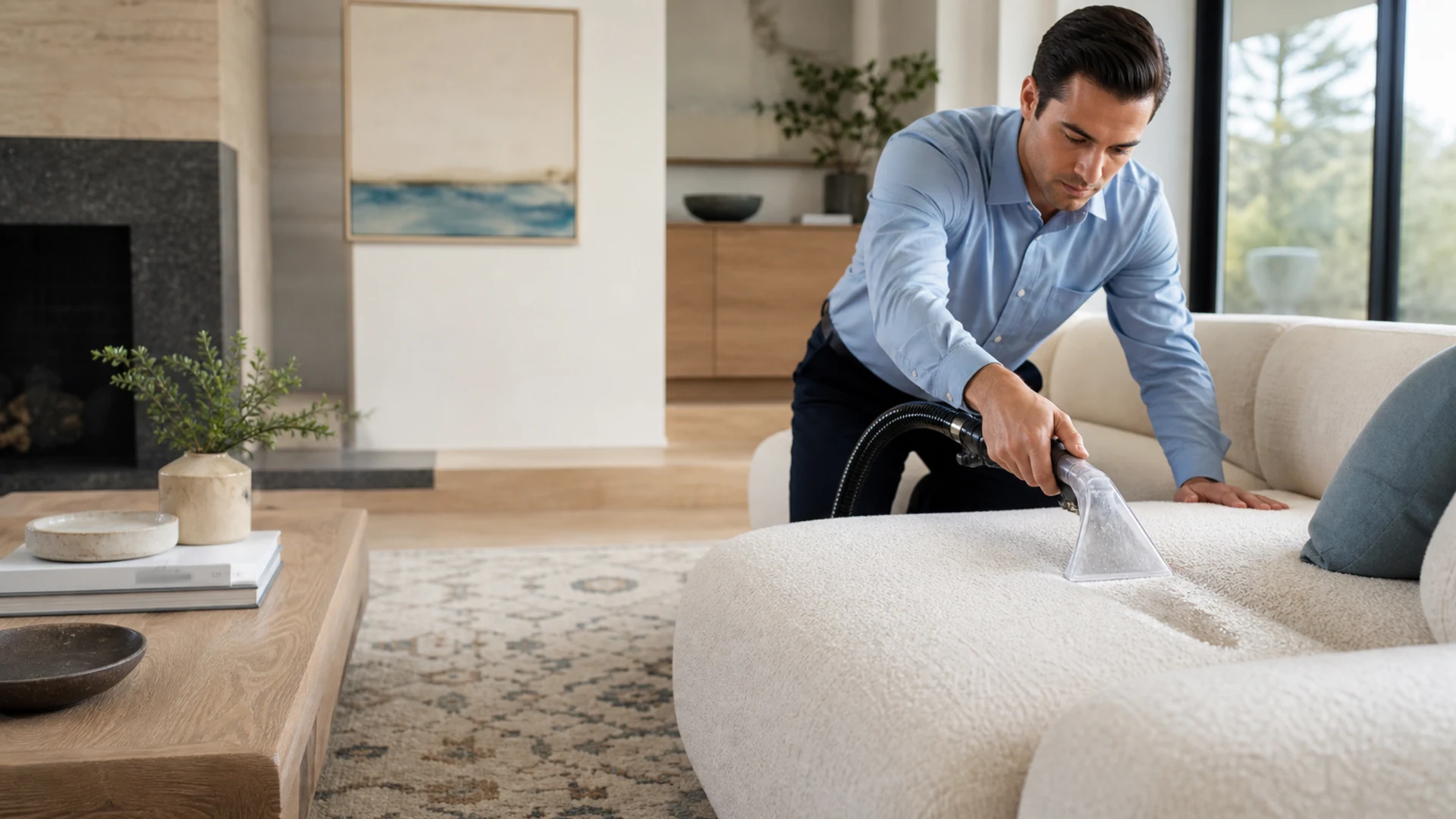
Learn how to check care labels, test safely, control moisture, and recognize when upholstery needs a professional.
Start with the manufacturer's care label and upholstery code. Steam is not appropriate for every textile, backing, adhesive, dye, or protective treatment. Antique pieces, unknown fabrics, silk, some velvets, and items marked for specialist care should not be used as a testing ground.
Vacuum compatible upholstery gently with a clean, soft attachment before adding moisture. Test the steamer on a concealed area using the lowest effective setting, then allow the spot to dry completely. Check for dye transfer, distortion, water marks, texture changes, or adhesive odor before continuing.

Use only the water and additives permitted by the steamer manufacturer; distilled water is often the safest simple choice. Essential oils and fragrance products can damage the machine, stain fabric, or create sensitivity concerns, so they do not belong in the reservoir unless the manufacturer expressly approves them.
Keep the head moving and avoid pressing it into the fabric. Work in small sections with light, even passes, following the direction of the nap where relevant. The goal is to relax a wrinkle, not saturate the cushion or force heat deep into its filling.
Provide airflow and allow the piece to dry fully before use. Do not replace cushions, sit on the upholstery, or cover it while it remains damp. Stop immediately if the material darkens unevenly, releases color, develops an odor, or changes shape.
Record the care code and the method that proved safe so future maintenance does not begin from guesswork. Deep stains, odor within the filling, delicate trims, and valuable textiles are better assessed through a professional carpet and upholstery service than repeatedly treated at home.
Read the upholstery before choosing steam
Steam is not a universal refresh button for upholstered furniture. Begin with the maker label, care instructions, warranty terms, fabric specification, and any upholstery cleaning code attached beneath a cushion or frame. Those sources may restrict water, heat, extraction, solvents, or consumer equipment, and a missing label does not grant permission to experiment. Identify whether the visible textile is natural, synthetic, blended, pile, coated, printed, or embellished, and remember that the face fabric is only one layer.
Backing, adhesive, interlining, padding, decking, trim, thread, dye, and the underlying frame can react differently when warmth and moisture pass through the surface. When the label is missing, request the purchase record, fabric memo, reupholstery invoice, or maker contact from the owner or designer; appearance and burn tests are not substitutes for authorized identification. Confirm whether the upholstery was supplied as a custom combination, since the furniture maker, textile mill, workroom, and protector installer may each hold a different part of the valid care information.
Ask what has already happened to the piece. Previous spot treatment, protector, household spray, pet accident, fragrance oil, sun exposure, reupholstery, or an undocumented cleaning can change the risk even when the fabric looks stable. Inspect for colour variation, brittle fibres, distorted nap, loose seams, weakened trim, water rings, dye transfer, odour, and marks that may be permanent damage rather than soil. Photograph conditions only with permission and keep the image focused on the service issue.
For antiques, valuable designer pieces, silk, velvet, leather, suede, delicate natural fibres, or unknown constructions, arrange specialist assessment instead of using a steam wand as a diagnostic tool. Share previous-treatment history with the specialist even when the earlier attempt seemed harmless, because protectors, solvent residue, household remedies, and partial wetting can influence the next safe choice. Include the affected faces and approximate dates rather than saying the entire piece was cleaned, helping the assessor distinguish an old treatment boundary from current soil or wear.
Prepare the room and perform a meaningful hidden test
Vacuuming is the first material-care step, not a cosmetic prelude. Use a clean, suitable upholstery attachment and controlled suction to remove loose grit, crumbs, hair, and lint before moisture can carry them farther into the textile. Check crevices for coins, jewellery, pins, glass, toys, controls, and loose hardware, and return personal items through the agreed household process. Support removable cushions as their construction permits, note their orientation, and do not unzip or expose fillings unless the maker instructions and scope allow it.
Protect adjacent floors, wood, metal, walls, and electronics from condensation, drips, hot tools, hoses, and the equipment path. Test suction at an inconspicuous edge and reduce it where loose weave, fringe, piping, or an unstable seam begins to move, using a screen or alternate method only when professionally specified. Inspect the attachment and hose for grit, dye, fragrance, and residue from earlier work, then clean or replace them before they approach a pale or highly textured textile.
A hidden test should reproduce the proposed method on a genuinely inconspicuous area without saturating it. Compare the test after it has dried, not merely while the fibres are darkened by moisture. Look for colour movement onto a white cloth, texture change, pile distortion, shrinkage, watermarking, adhesive release, sheen, stiffness, odour, or a boundary line.
A favourable small test reduces uncertainty but does not guarantee that a large seat panel, stained zone, or differently worn cushion will behave identically. Record the machine setting and contact method so the full treatment does not quietly become hotter, wetter, or more aggressive than the trial. Mark the hidden-test boundary with a removable reference outside the textile itself and allow the deepest affected layer to dry before comparing texture, odour, colour, and hand with the untreated area.
Set up the machine according to its actual instructions
Use only equipment intended for the task and operated by someone trained on that model. Inspect the cord, plug, hose, seals, reservoir, attachments, and safety controls before filling it. Place the unit on a stable protected surface where it cannot tip, block circulation, or become accessible to children or pets.
Follow the manufacturer direction for water quality and fill level; distilled or demineralized water may be recommended for some machines, but the manual controls that decision. Never open a pressurized cap, disconnect a hot fitting, or refill the unit before it has cooled and depressurized exactly as instructed. Establish a hot-tool resting point and an exclusion zone around the machine, and brief everyone present that apparently idle hoses, fittings, and condensate can remain hazardous during cooling.
Do not add essential oils, fragrance, vinegar, detergent, disinfectant, or improvised descaling agents to a steam reservoir unless the equipment manufacturer explicitly permits that substance and the textile method also supports it. Additives can damage components, leave residue, change emissions, affect occupants, or invalidate care guidance. Keep the electrical connection away from wet hands and damp flooring, and do not stretch a cord across a doorway without protection and supervision.
Confirm ventilation and nearby alarms before work, but never disable a detector or life-safety device. If the machine leaks, fluctuates, smells unusual, produces discoloured water, or fails a control check, remove it from service rather than troubleshooting it on the furniture. Empty and maintain the reservoir through the manufacturer procedure after use, storing the cooled machine open or closed exactly as directed so residue, pressure, and trapped moisture are not carried forward.
Control heat, moisture, movement, and textile direction
Begin with the least intensive approved setting and keep the attachment moving in an orderly path. The aim is controlled contact, not driving vapour deep into padding. Work a small area, overlap passes consistently, and avoid dwelling on piping, seams, tufting, buttons, glued details, corners, and compressed edges where moisture can concentrate.
Hold and angle the tool as the equipment guide specifies so hot condensate does not spit onto the textile or the operator. Use a clean absorbent barrier or bonnet only when it is part of the approved system, changing it before transferred soil is redeposited. Sketch a pass sequence for large cushions and panels before starting, keeping overlaps, edges, and untreated control areas consistent enough to assess the result after drying.
Respect the direction and construction of the surface. Velvet and other pile fabrics can show tracking, crushing, shading, or irreversible texture change when brushed or heated incorrectly. Printed textiles may release colour unevenly; blended fabrics may dry with different tensions; loosely woven material can snag under an attachment. Treat spots only with a compatible, identified method rather than repeatedly steaming them in the hope that heat will solve the chemistry.
Protein residue, oily soil, dye, ink, adhesive, and water-soluble marks behave differently. If the area expands, the cloth shows colour, the hand of the fabric changes, or an odour intensifies, stop immediately and reassess after the test area is fully dry. Classify isolated spots separately from general soil and obtain treatment guidance for each, because repeatedly exposing an unidentified mark to heat may set, spread, or visually enlarge it.
Manage drying as part of the service, not an afterthought
Moist upholstery should dry promptly and evenly under safe indoor conditions. Encourage air movement and ventilation in a way that suits the building, weather, security, and occupant needs; use clean fans only when they can be positioned stably and their cords do not create hazards. Do not press cushions together, replace impermeable covers, or allow people and pets to sit on treated areas before the textile and underlying layers are confirmed dry.
Direct intense heat can create its own damage, so heaters, hair dryers, and close sun exposure are not shortcuts. Return cushions to the position specified by their construction and maintain space for air to move around all treated faces. Note ventilation conditions, room humidity concerns, cushion orientation, and the start of drying in the handover, giving the follow-up person practical context without claiming a universal drying time.
Check with touch, appearance, and time, while recognizing that a dry face can conceal moisture within padding. Persistent dampness, browning, tide lines, colour shift, musty odour, foam distortion, or a slow-drying seam requires escalation. Do not mask an odour with fragrance or close the room and hope it resolves. Note the treated areas, ventilation setup, expected access restriction, and who will perform the follow-up check.
In a staffed residence, communicate the boundary to household personnel; in an occupied home, give the resident a clear, conservative handover. A refined finish includes the waiting period and the honest acknowledgement that safe drying cannot be compressed into a staged reveal. Use a discreet do-not-use notice that states which pieces or faces remain damp and who will release them, then remove it only after the agreed inspection rather than by a guessed deadline.
Choose specialist care when the desired result exceeds the method
A professional upholstery cleaner can evaluate fibre, construction, soil, previous treatments, and the need for extraction or solvent-based methods with tools designed for the piece. A textile conservator may be appropriate for culturally significant, antique, fragile, or exceptionally valuable furnishings. Water damage, bodily fluids, pest contamination, smoke, unknown chemical residue, widespread pet urine, mould-like growth, and deeply saturated padding are not routine steam-wand assignments.
They may require health-and-safety controls, removal of affected layers, restoration, or replacement. Likewise, a broken spring, unstable frame, failed foam, torn seam, or delaminating backing needs repair rather than more cleaning. Give the specialist clear photographs where permitted, dimensions, fibre information, construction notes, previous products, and the observed reaction, reducing the chance that the first site visit repeats an unsuitable experiment.
Close the visit with an evidence-based care recommendation, never a guarantee that a stain will disappear or that steam has sanitized every layer. Explain what was inspected, what limited test was performed, what changed after drying, and what remains. Keep the maker care information with the property record and list only the product or equipment details needed for continuity.
If a recurring refresh is appropriate, define vacuuming, rotation, spot-response boundaries, ventilation, and periodic reassessment rather than scheduling steam by habit. The real secret is restraint: a small wand can be useful within a verified system, but the premium decision is knowing when fabric, construction, or circumstance calls for a different professional altogether. After treatment, protect the piece from immediate spills and abrasion without wrapping damp fabric, and keep the approved vacuuming, cushion rotation, and incident-response guidance with the household care file.
Make the insight part of your routine.
The best property standards are easy to repeat. Capture the detail, stage what is needed, and give your concierge team the context to refine it.
Read the upholstery before choosing steam
Steam is not a universal refresh button for upholstered furniture.
Prepare the room and perform a meaningful hidden test
Vacuuming is the first material-care step, not a cosmetic prelude.
Set up the machine according to its actual instructions
Use only equipment intended for the task and operated by someone trained on that model.
Continue the subject
More Guides and Services for Deep cleaning and finish care
Follow the same care intent into adjacent rooms, materials, and decisions without losing the boundaries that protect the property.
Check Bay Area service availabilityLeave the execution to Skye.
Tailored scopes, vetted specialists, and follow-through designed around your property.
Carpet and Upholstery Cleaning Across San Francisco and the North Bay
Careful cleaning for compatible carpets, rugs, and upholstered seating, selected around fiber type, construction, color stability, and condition.

Recurring House Cleaning in San Francisco and the North Bay
A considered weekly or biweekly routine that keeps your home beautifully maintained without interrupting the way you live.
Worth returning to?
Save this field note or share it with the person who helps care for your space.
Experience the Skye standard in your own space.
We will map your property, align finish-safe products, and select the right specialists so impeccable becomes the baseline, not another task on your list.
Your next step
Tell us what needs to feel different. We will design the path to get it there.
